

The imaginary tab.
Kristen and Justin's farm. Unincorporated Virginia.

“Now that here, now, that’s a baby Copperhead snake,” Kristen said to my seven-year-old daughter. “You’re gonna wanna take a step back. You don’t want to get in the way of one of those. They’re venomous.”
I should have been worrying about my daughter getting bitten by a snake at this moment. And, yes, I was.
But something else was also nagging at me.
My bill.
Or rather, my lack of a bill.
We were camping on Kristen’s land for free, and I couldn’t understand why. Usually, it cost us $100 to camp our van on a campground. Why didn’t she want the money? My dog was roaming around on their land with her dogs, like he was one of the pack. Was this ok? Should I put him in his crate in the van?
She gave us a full spread of snacks when we got in. Was I supposed to pay her something? Reciprocate? Did we even have anything left from the last Wal Mart pitstop?
I was sweaty, physically, and uncomfortable, socially.
I didn’t understand free Virginia farm customs. What was the etiquette here? Was I rude for not bringing a gift?
As soon as the snacks were done, Kristen insisted that me and the girls leave our hot, humid van for a buggy tour of her sprawling 1,600 acres of Virginia forest. Her enthusiasm for the land was palpable and infectious. She was raised in Washington, DC and came to Virginia for college. She fell in love with the land, the horses, and Justin, her husband now. She never went back home. This land became home. It was hard not to smile no matter how many dogwoods she showed us. It was like she was a teenager, showing you a scrapbook of every clipped magazine picture she could find of the latest heart throb.
“Oh, I wish you could have seen it just a few weeks ago,” she says, disappointed for a brief moment. “The hills were just covered in our blooms. It was all white. Like Virginia snow.”
Over 90 minutes, she encouraged us to jump into streams, she pointed out woodpeckers, and she showed us her home. We met her horses, delighted that one of them was also named Tater. She pointed into the distance to where Justin’s dad, mom, sister, brother, aunt, great aunt, and great uncle all live in nearby plots of land, creating a commune that many of us can only dream of living on.
“Come check out these bear prints!” she said, smiling over her shoulder and motioning my daughters over. “Look how big their paws are!”
You got the feeling that even if we weren’t there, this is how she’d be spending her day.
And yet, I could not shake the feeling that we were a nuisance. That we were inconveniencing her from doing the things she wanted to do. And I kept thinking about the imaginary, non-existent tab.
We already had a free night stay. Free snacks. And now a 90-minute sightseeing tour? If I’d booked this through a guide, this could have cost us $75. I did the math. Our non-tab was running at about $210 by now.
I kept thinking the same five words: What’s in it for her?
Later that evening, Kristen made our entire family a delicious dinner and invited some of her family over too. She told us more about hosting people like us.
“When we moved to this farm, the only people I would talk to were my husband, my dad, and my kids,” she says. “Since I started hosting last year, people come by most days in the summer. We get to meet new people every day. It’s so fun for me.”
“We’ve met people from Uganda, Kenya, and the Netherlands,” Justin added. “It’s opened up our world beyond this farm.”
Fascinating, but I was still doing the math in my head as I ate. She’d even accommodated our dietary restrictions. Sure, we paid her daughter for horse riding lessons, but I just felt like I wasn’t contributing my share.
Should we have brought something for dinner? The nearest grocery store was at least 25 minutes away. How could we do that? I was failing at being a polite guest.
At that exact moment, Justin let a “damnit” slip, and my 9-year old said: “You owe me $1 for the curse jar!” He laughed and reached for his wallet. The idea of adding to my debt almost made me jump out of my chair. I quickly refused on her behalf with a tight smile, shooting her a look. Ignoring me, she recounted the fee-per-curse word structure for him for future reference. ($50 for the f-word?) Unbelievable. I was sitting here, my brain filling in an imaginary spreadsheet, trying to figure out how to repay these debts, and my kid was negotiating a cost-per-curse-word fee.
After dinner, we helped them clean up (Ha ha! I was balancing the scales!) and spent a few minutes watching Family Feud with Kristen’s dad. Eric and the girls then walked out to play softball in the twilight and Justin grabbed his mitt too.
“Mind if I join ya?”
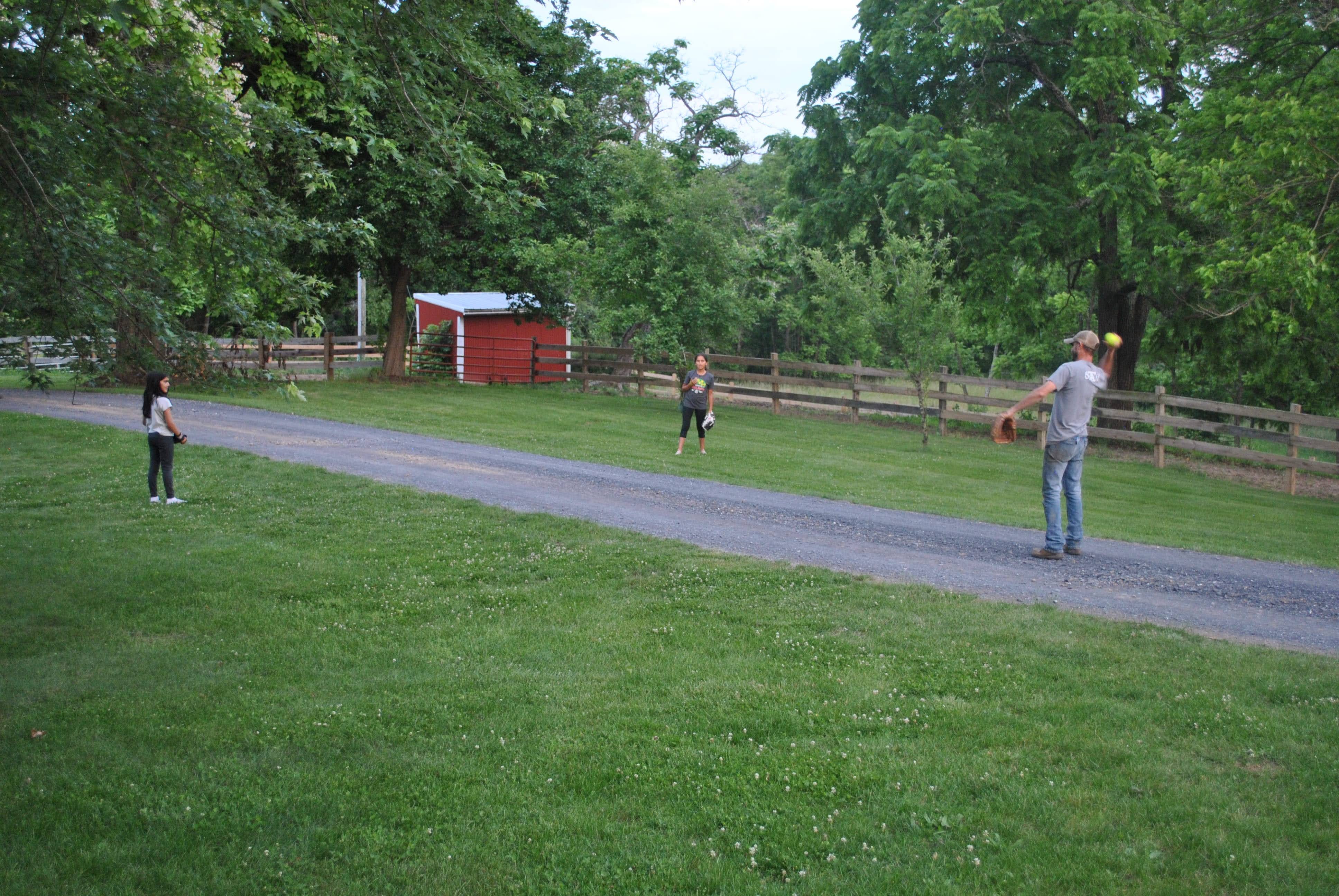
The four of them sauntered into an honest-to-God, Norman Rockwell painting. They spent the next hour standing in the shape of a square, chucking the ball from one person to the next. Justin taught my 7-year old how to throw a curveball. Justin spoke about how his daughter played shortstop like my 9-year old, and how her team had won state championships.
“I love playing ball so much,” Justin says, throwing the ball to Iyla. “My problem was that I was a genius with the mitt but couldn’t hit the ball for the life of me.”
I sat on a checkered picnic blanket with my dog, watching them. It was hard to conjure up a more American moment than this. Me and Tater on a farm in Virginia surrounded by fireflies, with my daughters learning to throw softballs at dusk from a farmer named Justin who was struggling not to say the f-word so he wasn’t charged $50 by my little California hustlers.
It was like I psychologically split in two at that moment. I both wanted to soak in the purity and the wholesomeness of this scene. The feeling of openness I felt with this family, this land, the animals… to it all.
But also, I still couldn’t keep doing the math. These kids were now getting a softball lesson! And Tater had essentially had a full day of doggie day care running around the farm all day, being looked after by the other dogs.
It had to be close to $400 by now.
We were strangers. They didn’t know us. We were Californians from across the country. We would probably never see one another again.
What were they getting out of this?
As dusk fell, Justin thanked us: “I don’t get to do this anymore. My kids are 18 and 21. I miss these days. You brought them back for me.”
Kristen hosted people on this farm because she shared company with people she’d otherwise never meet, and she’d spent the day telling me how meaningful our visit was for them. Justin said it had opened up his world. He got to play catch again and relive the memories of his kids being young.
But as I got ready for bed, I stared down at my Venmo app on my phone. Did connecting with new people have a price tag? A value?
We had just shared an incredible day with complete strangers. But why could I not help but ask: “How much do I owe you?”
Rebuilding the ways in which we connect with one another:
On welcoming strangers: George
On sharing what you love: Miss Alice and Carl
On seeing ourselves in others: David
On sharing time: Miss Angie
On showing up: The women of Cafe Appalachia
I do this with everything -- this is why it's so hard for me to ask for help! Like, if someone helps me out with e.g picking up a kid, I think: have I picked up their kid enough to justify it, or will I now be in debt, waiting for the chance to pick up their kid so that I can breathe a sigh of relief? And I theoretically know that people like helping other people -- I know because I like helping other people! But knowing that doesn't help!
Sheela - I love these shimmering stories and revelations - makes me feel so optimistic about humanity (& no AI appears in any of them)!